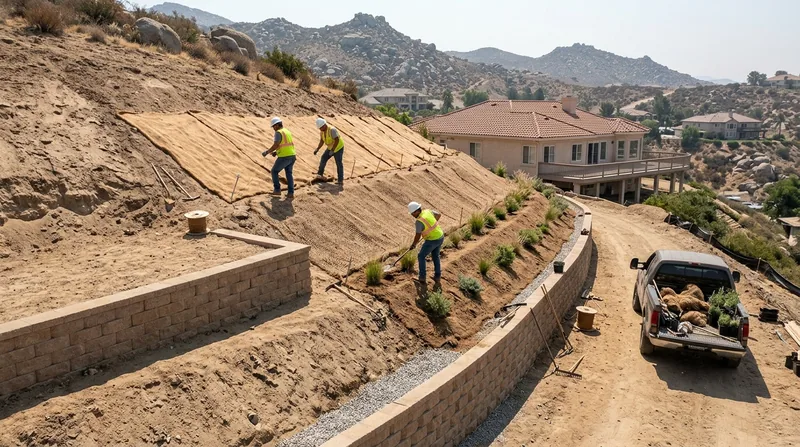




Slope Stabilization & Erosion Control in Riverside: Built for Our Granite Hills and Arroyo Banks
Riverside spreads from the flat Wood Streets grid of 1910s Craftsman and Spanish Revival homes up onto the granite hills of Canyon Crest, Hawarden Hills and Alessandro Heights, where 1970s to 2000s ranch and stucco tract homes sit on cut pads among natural boulders below Mount Rubidoux and the Box Springs Mountains. That cut-and-fill ground is sandy decomposed granite on the slopes and alluvial silt toward the Santa Ana River, and the Tequesquite Arroyo cuts through the older neighborhoods. When rare but intense winter storms hit, water washes decomposed granite out from behind walls, arroyo banks erode, and weep holes clog. Slope Stabilization & Erosion Control in Riverside means holding that hillside in place before a driveway, patio, or foundation starts to move. We build terraced retaining walls, set geogrid reinforcement, and install erosion control that protects homes on cut-and-fill lots and along arroyo banks. If a wall is already leaning or a slope is sliding, start with leaning and collapsed wall repair.
Why Slope Stabilization & Erosion Control Matters on Riverside's Hillsides
Most of the slope failures we see in Riverside trace back to water, not to the wall material. On the granite hills of Canyon Crest and Hawarden Hills, a hard winter storm dumps rain faster than decomposed granite can absorb it, and the saturated soil pushes against walls that were never built for that load. Down along the Tequesquite Arroyo, bank erosion undercuts footings and clogged weep holes let hydrostatic pressure build until a wall leans or a section collapses.
- Cut-and-fill lots leave a steep, unprotected face uphill of the house that sheds water and soil onto patios and driveways.
- Clogged weep holes and blocked drains trap water behind the wall, which is the single most common cause of a leaning wall in Riverside.
- Arroyo bank erosion slowly removes support under old timber planters and CMU walls near the Tequesquite Arroyo.
- Bare decomposed granite slopes wash out in sheets during intense winter storms and deposit silt against foundations and fences.
Stabilizing the slope and managing the water is what keeps a retaining wall standing through the next storm season.
Key info: In Hawarden Hills and Alessandro Heights, we routinely find timber planters from the 1970s rotted through at the base, with decomposed granite washing out behind them. Replacing that timber with a terraced segmental block wall and a proper drainage blanket stops the erosion and the wall movement in one job.
Before you plan any work, check the City of Riverside building department permit requirements for walls and grading, since thresholds vary by height and surcharge: City of Riverside.
How We Stabilize a Riverside Slope, Step by Step
Every slope job starts with reading the ground. On a cut pad in Canyon Crest, that means checking where the water comes from uphill, how deep the decomposed granite goes before it hits rock, and whether the existing wall is holding back saturated soil. We then build the fix around drainage first, structure second, because a wall that cannot drain will fail no matter how heavy the block.
- We walk the slope and map the water path, the soil layers, and any existing wall or footing that is still sound.
- We excavate and shape the slope into terraces so each wall carries a manageable height of soil.
- We install subsurface drainage, a gravel drainage blanket, and filter fabric behind the wall to move water out and keep fines from clogging the system.
- We lay geogrid reinforcement in lifts between block courses to tie the wall back into the stable soil mass.
- We build the wall in segmental block, poured concrete, or native granite boulder, matched to the slope and the house.
- We finish the bare ground with erosion control (slope matting, gravel, or drought-tolerant planting) so rain does not restart the washout.
Each step is inspected before we backfill, so the drainage and reinforcement are correct before they are buried.
Key info: On a recent job above the Tequesquite Arroyo, an old timber planter was pushing out because the arroyo bank had eroded behind it. We rebuilt the bank with boulder toe protection, replaced the timber with a segmental block terrace, and tied the drainage into the arroyo outlet. That is the pattern for most arroyo-side properties in Riverside.
For hillside properties in the 92501 area, see our Riverside 92501 slope stabilization page for local detail.
Slope Stabilization & Erosion Control Approaches We Use in Riverside
The right approach depends on slope height, soil, access, and what the slope is protecting. On a tight Canyon Crest lot, a boulder wall may be the only thing that fits; on a wide Eastvale pad, terraced segmental block with geogrid usually gives the most wall for the money. We match the method to the ground, not the other way around.
| Approach | Description | Best for |
|---|---|---|
| Terraced segmental block walls | Stacked block terraces with geogrid layers tying each wall back into the slope. | Cut-and-fill lots in Canyon Crest and Alessandro Heights with room for two or three short walls. |
| Boulder toe and bank protection | Native granite boulders keyed into the slope base to stop undercutting and erosion. | Arroyo banks and steep granite slopes where access is tight and the look should stay natural. |
| Poured concrete retaining walls | Reinforced concrete walls with a designed footing and drainage behind the face. | Taller walls and slopes that carry a surcharge such as a driveway or structure. |
| Surface erosion control | Slope matting, gravel cover, and drought-tolerant planting to hold bare decomposed granite. | Open slopes above a wall or below a pad where sheet wash is the main problem. |
| Drainage retrofit | New weep holes, gravel blanket, and outlet piping added to an existing wall. | Walls that are still standing but show water pressure, staining, or minor lean. |
We choose the approach that fits the slope and the budget, and we tell you plainly when a cheaper fix will not hold.
Slope Stabilization & Erosion Control Cost in Riverside: What to Expect
Every slope job starts with a free estimate, and that on-site look is what turns a ballpark into a real number. Slope stabilization is priced by the square foot of wall face, the height of the slope, and the amount of drainage and reinforcement the ground demands. A short terraced wall on a stable pad in Eastvale is a different job from a boulder bank rebuild on an eroded arroyo edge, and the price reflects that.
The main cost drivers we see in Riverside are slope height and the number of terraces, soil depth over rock (decomposed granite over granite is common on the hills), access for equipment on tight hillside lots, how much drainage and geogrid the wall needs, and whether the work protects a structure or a driveway. Emergency work after a storm adds cost because the slope is already moving. Getting two or three estimates is smart, and it lets you compare what each contractor includes for drainage and reinforcement, which is where cheap bids cut corners.
See our full pricing overview for line-item detail, then call for a site-specific number.
Slope Stabilization & Erosion Control Near Me: How to Hire a Retaining Wall Contractor Near Riverside
Hiring for slope work near Riverside comes down to proof, not promises. Ask for the license and insurance certificate, confirm the contractor has built walls on ground like yours, and get at least two or three written estimates that spell out drainage and reinforcement. Check references from hillside jobs, and ask how they handle permits, since walls above roughly 4 feet or walls that support a surcharge often need a permit and sometimes engineered drawings. If your property is in an HOA, confirm the wall style and color are approved before work starts.
Reach us through our contact page to set up a free estimate.
Slope Stabilization & Erosion Control in Riverside: Pricing Guide
| Service | Price | Details |
|---|---|---|
| Free on-site estimate | Free | Slope walk, drainage review, and a written scope before any work is priced |
| Surface erosion control | Starting at $1,200 | Slope matting, gravel cover, and planting on bare decomposed granite; area size moves the price |
| Terraced segmental block stabilization | Starting at $45 per sq ft of wall face | Block, geogrid, drainage blanket, and backfill; slope height and terrace count drive cost |
| Boulder toe and arroyo bank protection | Starting at $60 per sq ft | Native granite boulders keyed into the bank; access and bank length move the number |
| Poured concrete wall with engineered footing | On estimate | Taller walls and surcharge loads need an on-site look and often engineered drawings |
| Drainage retrofit on an existing wall | Starting at $900 | New weep holes, gravel blanket, and outlet piping; wall length and outlet path affect price |
Indicative pricing, the exact cost depends on square footage, finish, and site access. Free personalized estimate within 24h at (951) 425-4346.


